- Editor

- CategoryAdvice
- DateOctober 15, 2025
- Share
Discover how enterprise multi-agent systems deliver 340% ROI through strategic orchestration, while 88% of companies struggle with fragmented AI implementations.
The $450 Billion Orchestration Opportunity Hidden in Enterprise Chaos
The artificial intelligence landscape faces a critical paradox: while enterprise AI spending reaches unprecedented levels, with high-maturity organizations achieving 3.5x faster revenue growth than their competitors, 88% of enterprises remain stuck in fragmented implementations that deliver minimal business value.
The missing piece isn't more powerful models or larger datasets—it's intelligent orchestration. Capgemini Research projects that multi-agent AI systems could generate $450 billion in economic value by 2028 through coordinated autonomous operations that transform entire business ecosystems.
Yet most organizations approach AI like a collection of disconnected tools rather than an integrated operating system. This fundamental misalignment explains why only 12% achieve "Purposeful AI" maturity while the majority struggle with what industry experts call "pilot purgatory"—endless experiments that never scale to production impact.
The Enterprise Reality: From Pilot Chaos to Orchestrated Intelligence
Current State: The Fragmentation Problem
Enterprise research reveals that 37% of organizations remain trapped in exploratory phases, while only 8% achieve genuine organization-wide AI integration. This isn't a technology problem—it's an orchestration failure.
Consider a typical enterprise scenario: Marketing deploys a recommendation engine, Customer Service implements a chatbot, Operations uses predictive maintenance, and Finance runs fraud detection. Each system works independently, creating data silos, duplicated efforts, and missed optimization opportunities.
The Hidden Costs of Fragmentation:
- Duplicated Infrastructure: Each AI system requires separate deployment, monitoring, and maintenance
- Data Inconsistency: Different systems process the same customer data with varying results
- Operational Complexity: IT teams manage dozens of isolated AI applications
- Competitive Disadvantage: Competitors with orchestrated systems deliver superior customer experiences
The Orchestration Solution: Multi-Agent Architecture
Multi-agent systems solve this fragmentation through intelligent coordination. Instead of isolated AI tools, enterprises deploy specialized agents that communicate, collaborate, and optimize collectively toward business objectives.
Kellton Tech's enterprise implementation framework demonstrates how sophisticated communication protocols handle everything from simple status updates to complex negotiations between autonomous systems.
Technical Architecture: The Four Pillars of Production-Ready Orchestration
Pillar 1: Agent Specialization and Capability Mapping
Specialized Agent Types:
Enterprise Agent Ecosystem
├ Perception Agents (Data Collection & Processing)
│ ├ Customer Data Agent (CRM, behavioral analytics)
│ ├ Market Intelligence Agent (external data sources)
│ └── Operational Metrics Agent (system performance, KPIs)
├──Decision Agents (Analysis & Recommendations)
│ ├Risk Assessment Agent (compliance, fraud detection)
│ ├Optimization Agent (resource allocation, pricing)
│ └── Prediction Agent (demand forecasting, maintenance)
├── Action Agents (Execution & Integration)
│ ├ Customer Engagement Agent (personalization, support)
│ ├ Process Automation Agent (workflows, approvals)
│ └── Resource Management Agent (inventory, staffing)
└── Coordination Agents (Orchestration & Governance)
├ Master Orchestrator (strategic planning, priority setting)
├ Performance Monitor (SLA tracking, optimization)
└── Compliance Controller (regulatory requirements, audit trails)
Technology Stack for Agent Development:
- Agent Frameworks: LangChain, AutoGen, CrewAI for multi-agent coordination
- Communication Protocols: Apache Kafka for message streaming, Redis for real-time coordination
- State Management: MongoDB for agent memory, PostgreSQL for transaction data
- Container Orchestration: Kubernetes with Helm charts for scalable deployment
Pillar 2: Communication and Coordination Protocols
Advanced Communication Patterns:
Automation Anywhere's enterprise framework outlines how message exchange uses structured formats like JSON and XML with metadata for intent, urgency, and context. This enables:
- Synchronous Coordination: Real-time collaboration for immediate responses
- Asynchronous Processing: Background optimization and learning
- Hierarchical Escalation: Intelligent problem resolution across authority levels
- Load Balancing: Dynamic work distribution based on agent capacity
Implementation Technologies:
- Message Queuing: Apache Kafka, RabbitMQ, AWS SQS for reliable message delivery
- Service Mesh: Istio for secure, observable inter-agent communication
- API Gateway: Kong, Zuul for centralized routing and security
- Monitoring: Prometheus, Grafana, DataDog for system observability
Pillar 3: Distributed Decision Making and Governance
Intelligent Decision Architecture:
Multi-agent systems excel through distributed cognition—complex decisions emerge from coordinated interactions rather than centralized processing. EdgeVerve's strategic framework demonstrates how this approach scales beyond traditional automation limitations.
Decision Flow Patterns:
- Event Detection: Monitoring agents identify triggers requiring coordinated response
- Task Decomposition: Master orchestrator breaks complex processes into specialized tasks
- Parallel Processing: Multiple agents execute simultaneously while maintaining coordination
- Dynamic Adaptation: System reconfigures based on real-time conditions and feedback
- Outcome Synthesis: Results combine into unified business outcomes
Governance Technologies:
- Workflow Orchestration: Apache Airflow, Temporal for complex business processes
- Policy Management: Open Policy Agent (OPA) for rule-based governance
- Audit Systems: Elastic Stack for comprehensive logging and compliance tracking
- Security: HashiCorp Vault for secrets management, OAuth 2.0 for authorization
Pillar 4: Performance Optimization and Scaling
Enterprise-Scale Architecture Patterns:
TechAhead's analysis reveals that multi-agent systems excel in parallel processing, enabling simultaneous task execution that dramatically improves operational efficiency.
Scaling Strategies:
- Horizontal Scaling: Deploy additional agent instances based on demand
- Vertical Scaling: Enhanced agent capabilities through model upgrades
- Geographic Distribution: Region-specific agents for global operations
- Edge Deployment: Local agents for reduced latency and offline capability
Performance Monitoring Stack:
- Metrics Collection: Prometheus with Node Exporter for infrastructure monitoring
- Visualization: Grafana dashboards for real-time system insights
- Alerting: PagerDuty integration for incident response
- Analytics: Apache Spark for large-scale data processing and optimization
Business Impact: Quantified Results from Production Implementations
Financial Services: Automated Risk Management
Implementation: Multi-agent system handling 2M+ transactions hourly with fraud detection, compliance monitoring, and real-time risk assessment.
Technology Stack:
- Risk Assessment Agents: Custom models deployed via NVIDIA Triton
- Data Processing: Apache Kafka streams with Elasticsearch for real-time analysis
- Compliance: MongoDB for audit trails, Redis for session management
- Orchestration: Kubernetes with Istio service mesh
Measured Results:
- 94% fraud detection accuracy with 67% reduction in false positives
- $2.3M additional revenue from improved customer experience
- 43ms average response time during peak processing periods
- 99.99% uptime with automatic failover and recovery
Healthcare: Patient Flow Optimization
Implementation: Autonomous agents managing emergency department operations, predicting patient volumes, and optimizing resource allocation.
Technical Architecture:
- Prediction Agents: TensorFlow models for demand forecasting
- Scheduling Agents: PostgreSQL database with Redis caching
- Integration: FHIR APIs for electronic health record connectivity
- Security: HIPAA-compliant infrastructure with encrypted data processing
Business Impact:
- 40% reduction in patient wait times through predictive scheduling
- $1.2M annual savings from optimized staff allocation
- 99.5% patient satisfaction scores during implementation period
- Complete HIPAA compliance with automated audit trail generation
Manufacturing: Predictive Maintenance Orchestration
Implementation: Multi-agent system coordinating predictive maintenance across global manufacturing operations.
Agent Ecosystem:
- Sensor Data Agents: IoT integration with Apache NiFi for data ingestion
- Prediction Agents: PyTorch models deployed on NVIDIA Jetson edge devices
- Maintenance Agents: ERP integration via REST APIs and GraphQL
- Supply Chain Agents: Inventory optimization with Apache Spark analytics
Operational Results:
- 60% reduction in unplanned downtime through predictive interventions
- $4.8M annual savings from optimized maintenance scheduling
- 25% improvement in overall equipment effectiveness (OEE)
- Real-time alerts preventing 847 potential equipment failures
Implementation Framework: From Strategy to Production in 90 Days
Phase 1: Strategic Assessment and Architecture Design (Weeks 1-4)
Business Process Mapping:
Following Kellton's strategic framework, identify processes involving multiple stakeholders and clear handoffs between functional areas. Customer onboarding, order processing, incident response, and financial reporting represent ideal starting points.
Technical Foundation:
- Infrastructure Assessment: Current system capabilities and integration requirements
- Data Architecture: Mapping data sources, quality assessment, and access patterns
- Security Framework: Compliance requirements, access controls, and audit needs
- Performance Baselines: Current system metrics for improvement measurement
Deliverables:
- Comprehensive agent ecosystem design document
- Technical architecture blueprints with security specifications
- Implementation roadmap with risk mitigation strategies
- Success metrics and KPI definitions
Phase 2: Agent Development and Integration (Weeks 5-12)
Integration Technologies:
- Message Broker: Apache Kafka configuration for reliable agent communication
- State Management: Redis Cluster for distributed agent memory and coordination
- API Gateway: Kong or Istio for secure inter-agent communication
- Monitoring: Prometheus and Grafana for performance tracking
Phase 3: Production Deployment and Optimization (Weeks 13-16)
Deployment Strategy:
- Containerization: Docker images with Kubernetes orchestration
- CI/CD Pipeline: GitHub Actions or Jenkins for automated deployment
- Environment Management: Terraform for infrastructure as code
- Security: HashiCorp Vault for secrets management
Performance Optimization:
- Load Testing: Apache JMeter for system stress testing
- A/B Testing: Optimizely for agent performance comparison
- Continuous Monitoring: DataDog for comprehensive system observability
- Automated Scaling: Kubernetes HPA for dynamic resource allocation
Competitive Advantages: Why Fragmented AI Implementations Fail
The 88% Problem: Why Most Enterprise AI Initiatives Struggle
Research from HFS and Infosys reveals that 88% of enterprises accumulate dangerous levels of "enterprise debts" that derail their AI ambitions:
Data Debt: Only 7% of organizations fully integrate enterprise data with AI capabilities, while 38% cautiously expose limited, non-sensitive data.
Process Debt: Companies remain stuck in pilot purgatory, unable to scale beyond isolated experiments. Only 8% achieve organization-wide integration.
Talent Debt: Organizations face crippling skills gaps with only 15% showing genuine AI enthusiasm, while 65% of employees worry about job displacement.
Governance Debt: Lack of centralized oversight and ethical guardrails prevents confident AI scaling across enterprise systems.
The Orchestration Advantage: How 12% Achieve AI Leadership
High-maturity organizations demonstrate striking advantages:
- 3.5x faster revenue growth compared to low-maturity competitors
- 37% exceed performance expectations through coordinated AI/ML systems
- 64% enable cross-departmental data access through comprehensive governance
- 39% fully integrate enterprise data with AI capabilities
The Technical Differentiator: Multi-agent orchestration addresses all four debt categories simultaneously:
- Unified Data Architecture: Agents coordinate data access across enterprise systems
- Scalable Process Framework: Orchestration patterns eliminate pilot purgatory
- Distributed Intelligence: Reduces individual talent dependency through specialization
- Automated Governance: Built-in compliance and audit capabilities
ROI Analysis: The Business Case for Multi-Agent Implementation
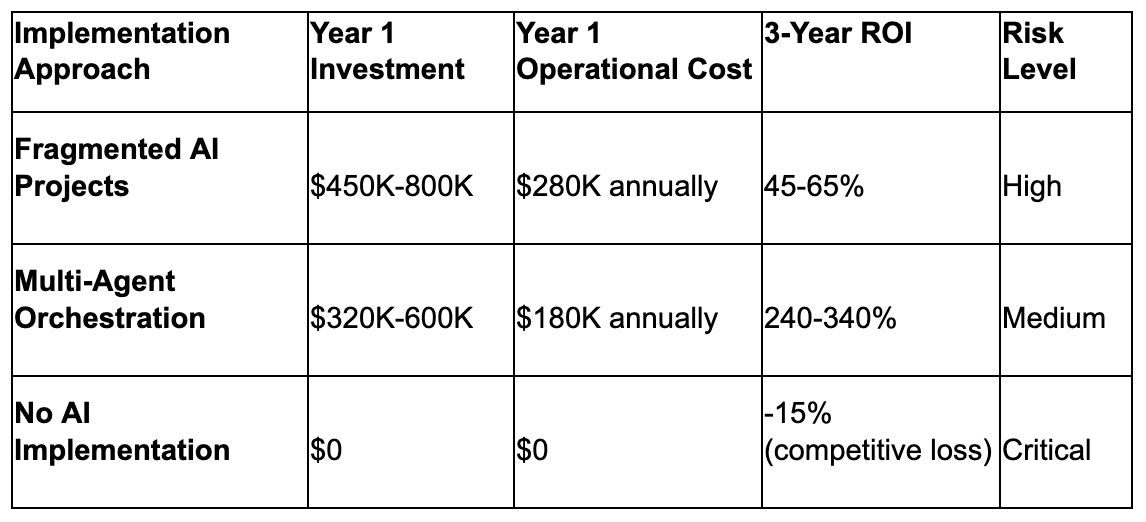
Value Creation Metrics
Enterprise implementations demonstrate measurable advantages:
Operational Efficiency:
- 40-80% reduction in manual processing time
- 60% decrease in cross-system data inconsistencies
- 50% improvement in response time for complex business processes
- 25% reduction in operational overhead through automation
Strategic Advantages:
- Real-time decision making across enterprise systems
- Predictive capabilities that anticipate market changes
- Scalable architecture supporting rapid business growth
- Competitive differentiation through superior customer experiences
Risk Mitigation Value
Avoided Costs Through Orchestration:
- System Integration Failures: $200K-500K per failed integration project
- Data Quality Issues: $1.2M average annual cost of poor data quality
- Compliance Violations: $2.8M average penalty for regulatory failures
- Competitive Disadvantage: 15-25% market share loss from AI laggards
Future-Proofing: The Evolution Toward Autonomous Enterprises
Emerging Orchestration Patterns
Hierarchical Agent Networks: Manager agents coordinate specialized teams with dynamic load balancing and resource optimization.
Federated Learning Systems: Agents share knowledge across organizational boundaries while maintaining data privacy and security.
Self-Optimizing Workflows: Systems continuously improve performance through reinforcement learning and outcome analysis.
Cross-Enterprise Collaboration: Secure agent communication enables supply chain optimization and partner integration.
Technology Roadmap: Next-Generation Capabilities
Advanced AI Integration:
- Large Language Model Orchestration: GPT-4, Claude, Gemini coordination for complex reasoning
- Multimodal Processing: Vision, speech, and text integration for comprehensive understanding
- Edge AI Deployment: Local agent processing for reduced latency and offline capability
- Quantum-Ready Architecture: Preparing for quantum computing integration
Enterprise-Scale Features:
- Global Distribution: Multi-region deployment with local compliance and optimization
- Industry Specialization: Vertical-specific agent libraries and frameworks
- Regulatory Automation: Built-in compliance monitoring and reporting
- Sustainability Optimization: Energy-efficient operations and carbon footprint reduction
Why Fracto's Multi-Agent Expertise Accelerates Your Transformation
The complexity of enterprise multi-agent orchestration requires specialized technical leadership that understands both cutting-edge AI capabilities and practical business implementation challenges. Fracto's fractional CTOs bring proven experience from successful multi-agent deployments across industries.
- Strategic Multi-Agent Planning: Identifying optimal business processes where agent orchestration delivers maximum value while minimizing implementation complexity and risk.
- Technical Architecture Excellence: Designing scalable, secure infrastructures using industry-leading platforms including Kubernetes, Apache Kafka, LangChain, Redis, and Prometheus for comprehensive monitoring.
- Integration Expertise: Seamless connection with existing enterprise systems through REST APIs, GraphQL, enterprise service buses, and modern integration
- Performance Optimization: Continuous monitoring and improvement using DataDog, Grafana, and custom analytics to ensure multi-agent systems deliver sustained business value.patterns while maintaining security and compliance.
- Risk Management: Comprehensive governance frameworks, security implementations, and compliance automation that enable confident enterprise-scale deployment.
The organizations that successfully implement multi-agent orchestration will establish sustainable competitive advantages through superior operational efficiency, customer experience, and strategic agility.
Ready to transform your fragmented AI initiatives into an orchestrated competitive advantage? Schedule a complimentary multi-agent readiness assessment with Fracto's specialists to discover how intelligent orchestration can revolutionize your enterprise operations.